



January 3, 2011
When Montana State University (MSU) initiated their search for a wind turbine to best meet their campus needs, it was by no means a menial task. Their research into wind turbines was thorough and extensive.
Montana State University’s campus is situated in the city of Great Falls, Montana. It borders a residential area to the west, a commercial area to the south, another college campus to the north, and apartment buildings and open land to the east. Due to the location of the campus, the acoustic profile of the turbine became an essential consideration throughout the research and selection process. Not only did the university want to find a wind turbine with acoustics that would not disrupt their neighbours, they also wanted to preserve the quiet learning environment of the campus.
There was a twofold purpose to installing a wind turbine: it would power their Skilled Trades Building and it would be used as an educational tool for their sustainable energy programs. In the fall of 2007, the university conducted feasibility and site assessment studies on the proposed campus turbine. Their site wind resource was assessed at a Class I-II, providing an average wind speed of 11.5-12.5mph. Due to net metering rules in the state of Montana, their turbine size was limited to 50kW. There were also other city regulations to be met. Based on the city’s sound ordinance, which limits the sound to 60-65dBA depending on the time of day, a conditional use permit for the turbine was issued. During the permitting process, residential neighbours personally voiced their concerns to MSU regarding the potential acoustic levels of the turbine.
Following the guidelines set out by their feasibility study and permitting steps, MSU began a rigorous review of the best 50kW wind turbines available in the marketplace. The review was spearheaded by Mel Lehman, Wind Montana’s Project Manager, who served as the environmental engineer and the principal decision maker for MSU’s wind turbine purchase. Also included in the review process were the Dean, the Associate Dean of Finance and Administration, the campus procurement specialist, the campus project specialist, and the facilities manager. The review committee hired a mechanical engineer with the State Department of Administration’s Architect and Engineering Division, as well as an Architect and Construction Management Specialist to work on their behalf. This team met numerous times over a period of several weeks to evaluate the market’s available 50kW wind turbines, basing their research on the criteria of quiet operation, turbine specifications, performance histories, company histories, and references.
In the fall of 2009, two years after they began their efforts to install a wind turbine, MSU narrowed their preferences to three 50kW wind turbines. Mel Lehman commented, "The Endurance Wind Power 50kW was ranked #1 for several reasons, including production potential in our wind regime, history of the technology, the reliability of prototypes in operation, the educational value to the University’s programs, and lower operational acoustic levels." The acoustic rating of 47dBa at 200 feet was well below the city’s sound ordinance and within the setbacks stipulated in their permit. While pre-planning for turbine installation was set into motion, Mel continued his due diligence with respect to researching the Endurance wind turbine. He spoke with two other Endurance customers. The first was the Sault College of Applied Arts & Technology, who reported that the turbine was "very quiet." The second customer contacted by Mel resided in Cornwall, England. This customer, whose turbine was installed only 70 meters from his house, told Mel that he could hear the turbine outside, but could not hear anything indoors. Mel, along with the Facilities Manager also took a trip out to the Endurance test facility to meet with a group of Endurance staff including a sales director, and a few of the engineers and technicians. He reviewed the details of the Endurance turbine, including another review of the quietness of its operation.
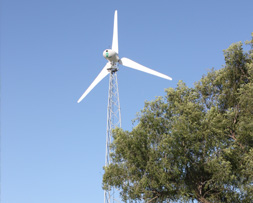
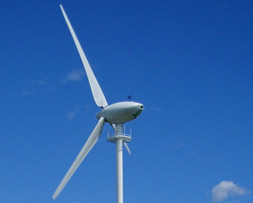
The MSU turbine was commissioned on April 9, 2010 and now sits atop a 120′ monopole on the southwest corner of the campus. The project engineers and designers expect to generate 150,000kWh annually. Mel commented, "We have not measured acoustic levels yet with a dB (A) meter, but our campus turbine is quiet. It is located about 90 feet from a campus parking lot and you have to go about 20 feet closer to actually hear it when winds are 8-15 mph. I anticipate that when we measure our campus turbine’s acoustic levels we will find the operational levels to be lower than the rated levels."
Following the turbine’s installation, MSU held a public information session for its surrounding community and for anyone who wanted to learn more about the campus’ wind turbine. Some of the residential neighbours, who had been originally concerned about the acoustics of the wind turbine during the permitting process, also attended. They expressed their satisfaction with the turbine and reported that it was "very quiet."
In the first seven months of operation, the wind turbine’s record daily output was 1126 kWh and highest monthly production was 8070kWh. Was MSU satisfied with their E-3120 wind turbine after their lengthy selection process? Mel declares, "The wind turbine selection process was lengthy, quite comprehensive, and involved several levels of professional expertise, approvals and public input along the way. The Endurance E-3120 has exceeded our expectations with respect to low operational acoustic levels; we are hoping it will also exceed our production estimates."
Quiet operation, production efficiency, and reliability were all deemed proven characteristics of the Endurance E-3120 as a result of MSU’s extensive research. MSU’s campus now has green energy that works… quietly!
© 2010, Endurance Windpower.
www.endurancewindpowerinc.com
Posted by admin on January 3, 2011
