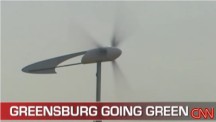
The Endurance
A Better Approach to Windpower
A look into our Engineers Design Specifications and Reasoning.
There is no debating that the Endurance is different from any other small wind turbine available today. This is no surprise since, unlike all other small turbines the Endurance is built to produce grid-compatible power right out of the generator.
Most small turbines today use permanent magnet (PM) alternators to generate power. This power is ideal for battery-charging or stand-alone, remote power applications, but it is not grid-compatible. This makes these small turbines a great choice for remote village applications, boats and RV's, or remote cabins (a small market that many of the small turbine manufacturers target) but not the most ideal choice for the large on-grid, corporate, agricultural or residential consumer market.
To connect a PM small turbine to a grid-connected home, the output must be rectified to DC, then converted to 60 Hz AC, and synchronized with the grid. This requires an inverter that essentially equates to an expensive adapter between the turbine and the home. The inverter adds a considerable expense that can amount to more than half the total wind turbine system cost in some cases. Magnifying the expense is the fact that the inverter must be massively oversized to handle the large over-speed (and hence over-power) events common with passive furling systems used on most small turbines.
The Endurance wind turbine was intentionally designed for the on-grid market from inception. By doing this we were able to completely eliminate these costly components and lower the overall system cost dramatically.
The Endurance is the only small wind turbine available on the market that produces AC power that is directly compatible with the power grid and thus foregoes the need for an expensive inverter or costly batteries. This is a major advantage for the Endurance in the rapidly growing grid-connected market. Note that the use of an induction generator (the most mass produced electro/mechanical machine in the world), such as the Endurance uses, is well proven and reliable. This technology is well-established and common in larger (75 - 250 kW) turbines used in wind farms that date back to the 1980's. Its absence in the small wind turbine market up until now is due to the fact that the biggest market for these small wind turbines had historically been remote, off-grid applications.
The Endurance Wind Power engineers observed an emerging trend towards clean energy that uses the power grid to facilitate the move from off-grid to an on-grid market, and as such it is expensive to retrofit existing wind turbines for compatibility.
Because the Endurance is designed for the on-grid market, and other small turbines are not, the Endurance incorporates parts that those familiar with current small wind technology might not find very familiar. In particular there are four features unique to the Endurance:
- An anemometer
- A large disk brake with two independent brake calipers
- A gearbox coupled to an induction generator
- A robust control system to monitor it all
Anemometer
The anemometer serves several useful functions, including allowing motor starts, and giving the controller the ability to evaluate system health by comparing rotor speed (which correlates to rotor power) to wind speed. Most importantly it helps determine more accurately when our cut-out wind speed has been reached. This is more important to the Endurance than any other small turbine because of the brake system employed. Most small turbines use passive furling systems that are not reliable enough, in our opinion, to prevent noisy and possibly dangerous rotor over-speed events during high winds. The Endurance braking system, on the other hand, quietly and safely brings the rotor to a complete stop in high winds, and the anemometer determines when those high winds occur.
Brakes
As previously mentioned, the Endurance was designed as part of an over-speed protection system (OPS) project. This is because we felt it is imperative to ensure safety, reliability and quiet operation in the corporate, agricultural and residential market where a wind turbine (necessarily) operates near homes and people.
We chose pneumatic brakes that are commonly used in the transportation industry; consequently parts are both inexpensive and dependable. We guarantee safety by employing two independent, fail-safe brake calipers, each with the ability to stop the rotor in the worst conditions. The brake is located on the rotor shaft, ahead of the gearbox. This arrangement protects the rotor against most drive train failures and isolates the gearbox from the braking torque - the highest torque that is applied to the drive train.
Gearbox and Induction Generator
The gearbox in the Endurance is key to allowing the use of an inexpensive, off-the-shelf induction generator, which costs significantly less than the custom permanent magnet generators all other small turbines employ. The induction generator must turn at speeds much faster than a quiet wind turbine rotor of this size. Generating power at high rotational speeds is an efficient method employed by all major power plants (e.g., gas turbine generators turn at thousands of RPM). The gearbox allows our slow (~ 200 rpm) rotor to turn the generator at 1,800 rpm. The induction generator in turn produces grid compatible 60Hz, 120 or 240 volt, single-phase power, allowing seamless grid-connection that results in overall reduced system cost.
Control System
Keeping all systems running smoothly is the control system. The controller determines when it is safe to start up the turbine, when it is necessary to shut down, and continuously monitors overall system health to ensure safe, reliable operation. Its design, along with the fail-safe brakes ensures that the Endurance rotor can never enter a runaway situation.
The control system uses the anemometer, and redundant speed sensors on both the high and low speed shafts. Crosschecking these signals allows the controller to shut down the turbine at the first sign of a problem. The anemometer and shaft speed sensors used are all common, well-established technologies widely available at reasonable costs.
The control system as a whole is fail-safe and redundant. Any problem from a small glitch to a total power loss leads to a safe system shutdown. The system has been thoroughly tested, and we stand behind our claim that "the Endurance will always be safe as well as look safe in all conditions." We know that rotor runaway (which in high winds can result in thrown blades or falling towers) is not an option, and thus we have designed that option out of the Endurance.
The control system also allows us to remotely monitor and even control the turbine operation via a wireless interface. This is a great feature in the on-grid, residential market, where the turbine will likely receive less attention from the owner than would an off-grid machine that is relied on as the sole power source. In designing a grid-compatible wind turbine, we had to keep in mind the fact that our customers are not dependent upon the turbine for power, but instead rely on it for achieving a specific (likely economic and/or environmental) goal. We know our customers appreciate not having to worry about whether the turbine needs servicing, or even if it is operating properly. The controller can assess all that, and then send the necessary information wirelessly to a home display unit we offer with the system.
This home display unit remotely interfaces to the turbine controller to provide feedback on system status, wind speed, power production, time until next service interval and whether any faults have been detected. A fault displayed on the home unit can be called in to our shop, thus allowing us to quickly and remotely diagnose - and perhaps even provide a solution to - any issues that may in the unlikely event arise. This will save an enormous amount of time, effort and money compared to the alternative of traveling to perform diagnostics onsite. In addition, the unit allows the user to safely stop the machine from inside their home with the press of a button. We know the home display unit will be a welcome alternative to traditional alternatives which require owners to go out to the turbine to shut it down or assess a problem. And owners who just have to know how their investment is paying off will delight in the display showing kilowatts being generated.