Product Features
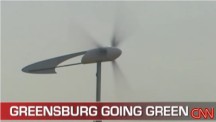
The Endurance Wind Power System comes in three different heights and two blade lengths. It is rated at 5 kW at 14 M/S hub-height wind speed. The design recognizes the need for safe, quiet and efficient operation in both the agriculture, residential and corporate markets. This is achieved in part through the low speed shaft brake system and the non-furling, upwind design.
Tower Heights
Endurance wind power turbines are specially designed as tilt-up tower systems and they come standard in the following three heights: 63 FT (19.2 M), 84 FT (25.6 M) and 105 FT (32.0 m).
Wind research and weather maps show that these heights are optimal from a cost/performance ratio depending on the specific location and siting of the wind turbine.
Wind speed, and hence power increases with height above the ground. The degree of increase depends on the surface roughness. For very smooth surfaces such as snow on flat ground or calm seas a doubling of the tower height results in a modest 25% increase in energy capture. For scattered trees and hedges energy production can be dramatically increased with a taller tower. For this surface roughness a doubling of the tower height will increase the yield by as much as 75%. Buildings or woodlands can further increase the energy yield of a taller tower.
Regardless of the surface roughness, the wind turbine must be sited outside of the turbulence zone of any obstacles. As a general rule of thumb the entire rotor disk should be at least 30 ft above any obstruction within 300 ft. According to Paul Gipe, an industry expert, "raising a small wind turbine above nearby obstruction is the single most effective way to increase performance!"
On-Grid Wind Turbine
The Endurance small wind turbine has been designed to connect directly to your home power source seamlessly powering your home when the wind is blowing or allowing for grid power consumption during calm periods. With net-metering, excess power generation will result in an accumulation of credit as the meter is spun backwards.
This design allows for a number of important advantages over other small wind turbines that have traditionally been designed for off-grid customers though with recent trends in the industry have been forced to offer their wind turbines for connection to the power grid.
Most notably, the Endurance wind turbine is designed without an inverter, an expensive component that is considered in the industry as the most unreliable component of any wind turbine system. The inverter also reduces system efficiency consuming as much as 25% of the electrical energy produced.
The use of an induction generator also aids in cost reduction and provides the Endurance with a passive yet very effective means of power regulation. The inherent, constant speed operation of the induction generator results in aerodynamic stall-control of the rotor for power regulation above rated wind speed.
Lastly, the constant speed operation provides one more benefit and that is lower rotor noise in high and gusty wind conditions. Most small wind turbines operated at variable speeds which often results in excessive over speeds during high winds and/or turbulent conditions, this is especially common for furling machines. Since the rotor noise is approximately a function of the 5th power of the tip speed, a 150% over speed event results in almost 8 times more rotor noise.
Control Panel Location
The majority of the controls that power the Endurance Wind Turbine are located down on the ground at the base of the tower. This provides for excellent system availability for routine maintenance. This feature is unlike many wind turbines whose controls are mounted up in the nacelle of the wind turbine, making it extremely difficult and expensive for maintenance or repair. This also serves to place delicate electronic equipment less exposed to potentially damaging lightning strikes as well as keeping it away from the constant vibration found in the wind turbine nacelle.
Blade Design
The Endurance employs advanced airfoils designed by the Department of Energy specifically for stall-control power regulation of wind turbines. As a result, the aerodynamic behavior of the blades during constant speed operation provides the Endurance with a very tight control on power regulation.
Stall-control works on the principle that the constant speed rotor experiences increasing angle of attack as the wind speed increases. When wind speeds exceed rated, the aerodynamically stalled region of the blade expands from root to tip. The Endurance comes close to an ideal design where the rotor efficiency drops (due to stall) at the same rate as the input energy increases (with wind speed) creating a nearly constant power output above rated. This response is high lighted in the plot below showing the energy in the wind fluctuating between 11 and 18 m/s - or an approximately 400% change in input energy - while the electrical power output only varies ~20%.
We have also created and specially designed leading edge vortex generators that improve performance by delaying the stall characteristics resulting in a near optimum power regulation in high winds
Anemometer
The anemometer tracks wind speeds and reports them back to the controller which aids in the efficiency of the Endurance Wind Turbine. The addition of an anemometer is designed to improve the energy capture of the wind turbine. This allows for a more accurate assessment of cut-in and cut-out wind speeds for deciding when to apply and release the dual brakes system.
When the anemometer senses cut-in wind speed has been reached, the induction generator is used as a motor to bring the rotor blades out of a deep stall. This facilitates and maximizes energy production in light winds sooner. Most small wind turbines are solely reliant on wind-starting the turbine in order to reach the cut-in wind speeds to produce power.
Dual Voltage Switching (Patented DVS System)
The Endurance control system incorporates our patent pending Dual Voltage Switching technology. It generates 120 VAC power in light winds and 240 VAC in higher winds. This technology greatly improves the efficiency of the generator in the more frequent, light winds. Switching between voltages is regulated by the control system and proprietary software makes for a smooth transition, maximizing performance and efficiencies in all wind conditions. The software code is designed to prevent excessive switching in variable winds.
Fault Tolerant - Overspeed Protection System
The Endurance Wind Turbine has been designed for maximum safety for it is built on the premise that people will be living, working and playing around the unit.
There are some key safety features in the design of the Endurance Wind Turbine that are not found in any other Small Wind Turbine. In fact, the Endurance design is designed around the same strict IEC standards that govern the large MW turbines.
Dual and redundant brake calipers can stop the rotor in the worst fault and wind combination. Redundancy ensuring that if one brake system fails the other brake will stop the rotors and park it - regardless of the circumstance.
In comparison, when designed properly, furling out of the wind can work 99.9% of the time. Unfortunately that is not enough to fully protect your wind system investment.